4.35. A cricket fielder can throw the cricket ball with a speed . If he throws the ball while running with speed u at an angle θ to the horizontal, find
a) the effective angle to the horizontal at which the ball is projected in the air as seen by a spectator
b) what will be the time of flight?
c) what is the distance from the point of projection at which the ball will land?
d) find θ at which he should throw the ball that would maximize the horizontal range as found c)
e) how does θ for maximum range change if ?
f) how does θ in e) compare with that for u = 0?
Consider the adjacent diagram.
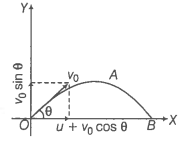
(a) Initial velocity in
where the angle of projection is .
Now, we can write
Step 2: Find the time of flight
(b) Let T be the time of flight.
As net vertical displacement is zero over the time period T
We know that
Step 3: Find the horizontal range.
(c)
Step 4: Apply maxima and minima and find the maximum horizontal ranges for different conditions.
(d)
(e) If
(f) If

© 2026 GoodEd Technologies Pvt. Ltd.