4.22ı→ and ȷ→ are unit vectors along x- and y- axis respectively. What is the magnitude and direction of the vectors

ı→+j→, andı→−j→? What are the components of a vector

A→=2ı→and3j⇀

along the directions of ı→+ȷ→and

ı→−ȷ→? [You may use graphical method]


NEETprep Answer:
 
Consider a vector 𝑃⃗⃗, given as:
P¯=i^+j^Pxi^+Pyj^=i^+j^
On comparing the components on both sides, we get:
Px=Py=11P1→=Px2+Py2=12+12=2

Hence, the magnitude of the vector ı→+ȷ→  is 2.
 
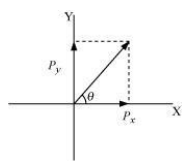
Let 𝜃 be the angle made by the vector 𝑃⃗⃗, with the x-axis, as shown in the following figure.


∴tan⁡θ=(PyPx)θ=tan−1⁡(11)=45∘   
Hence, the vector i^+j^ makes an angle of 45° with the x-axis.
 
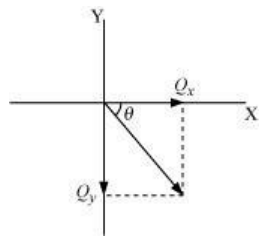
 Let Q→=i^−j^Qxi^−Qyj^=i^−j^Qx=Qy=1|Q¯|=Qx2+Qy2=2
Hence, the magnitude of the vector ı→−ȷ→ is √2.
 
Let 𝜃 be the angle made by the vector Q→, with the x-axis, as shown in the following figure.
 
∴tan⁡θ=(QyQx)θ=−tan−1⁡(−11)=−45∘Hence, the vector ı→−ȷ→ makes an angle of -45° with the x-axis.
 
It is given that:
A→=2i^+3j^Axi^+Ayj^=2i^+3j^On comparing the coefficients of i→ and j→, we have:
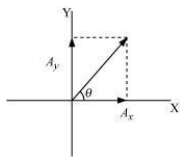
Ax=2 and Ay=3|A→|=22+32=13Let Ax→ make an angle 𝜃 with the x-axis, as shown in the following figure.
∴tan⁡θ=(AyAx)θ=tan−1⁡(32)=tan−1⁡(1.5)=56.31∘
The angle between the vectors (2i^+3j^) and (i^+j^),θ=56.31−45=11.31∘
 
Component of vector A→, along the direction of P→, making and angle 𝜃.
=(Acos⁡θ)P^=(Acos⁡11.31)(i^+j^)2=13×0.98062(i^+j^)=2.5(i^+j^)=2510×2=52Let θ be the angle between the vectors (2i^+3j^) and (i^−j^)θ′′=45+56.31=101.31∘
Component of vector 𝐴⃗, along the direction of 𝑄⃗⃗, making and angle 𝜃.
=(Acos⁡θ′′)Q¯=(Acos⁡θ)i−j2=13cos⁡(901.31∘)(i^−j^)2=−132sin⁡11.30∘(i^−j^)=−2.550×0.1961(i^−j^)=−0.5(i^−j^)=−510×2=−12