
 Q. No.
The coefficient of performance of a refrigerator is \(5.\) If the temperature inside the freezer is \(-20^\circ \text{C},\) the temperature of the surroundings to which it rejects heat is:
1. \(31^\circ \text{C}\)
2. \(41^\circ \text{C}\)
3. \(11^\circ \text{C}\)
4. \(21^\circ \text{C}\)


| 1. | \(\dfrac{T_1-T_2}{2} \) | 2. | \(T_1 T_2 \) |
| 3. | \(\sqrt{T_1 T_2} \) | 4. | \(\dfrac{T_1+T_2}{2}\) |
The temperature inside a refrigerator (reversible process) is t2oC and the room temperature is t1oC. The amount of heat delivered to the room for each joule of electrical energy consumed, ideally, will be:
1.
2.
3.
4.


A Carnot engine, having an efficiency of = as a heat engine, is used as a refrigerator. If the work done on the system is \(10\) J, the amount of energy absorbed from the reservoir at a lower temperature is:
1. \(100\) J
2. \(99\) J
3. \(90\) J
4. \(1\) J
The efficiency of a Carnot engine is 50% and the temperature of the sink is 500K. If the temperature of the source is kept constant and its efficiency raised to 60%, then the required temperature of the sink will be:
1. 100 K
2. 600 K
3. 400 K
4. 500 K
The ratio (W/Q) for a Carnot engine is . Now the temperature of the sink is reduced by 62ºC, then this ratio becomes twice. Therefore, the initial temperature of the sink and source are, respectively:
1. 33ºC, 67ºC
2. 37ºC, 99ºC
3. 67ºC, 33ºC
4. 97 K, 37 K


| Assertion (A): | Carnot engine is most efficient among all heat engines working between the same source and sink. |
| Reason (R): | The efficiency of the heat engine is independent of the nature of the working substance. |
| 1. | Both (A) and (R) are true and (R) is the correct explanation of (A). |
| 2. | Both (A) and (R) are true but (R) is not the correct explanation of (A). |
| 3. | (A) is true but (R) is false. |
| 4. | Both (A) and (R) are false |
A carnot engine having an efficiency of th of heat engine, is used as a refrigerator. If then work done on the system is 10 J, the amount of energy absorbed from the reservoir at lower temperature is:
1. 1 J
2. 90 J
3. 99 J
4. 100 J
Consider a heat engine as shown in the figure. are heat added to and heat taken from respectively, in one cycle of the engine. W is the mechanical work done on the engine.
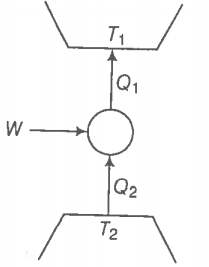
If W > 0, then possibilities are:
Choose the correct alternatives:
1. (b, c)
2. (a, d)
3. (b, d)
4. (a, c)


A steam engine delivers \(5.4\times 10^8\) J of work per minute and extracts \(3.6\times 10^9\) J of heat per minute from its boiler. The efficiency of the engine is:
1. \(15\%\)
2. \(18\%\)
3. \(13\%\)
4. \(11\%\)

© 2026 GoodEd Technologies Pvt. Ltd.