 Laws of Motion: Part 1 (Newton Laws + Tension+ Normal Reaction)Contact Number: 8527521718Laws of Motion: Part 1 (Newton Laws + Tension+ Normal Reaction)Contact Number: 8527521718
When a body of mass m raised by a string with an acceleration a = g in an upward direction, the tension in the string is:
(1) 2mg
(2) mg
(3)
(4) Zero
Three identical masses, each of mass \(4\) kg, are connected by massless inextensible strings. The string joining \(A\) and \(B\) passes over a massless frictionless pulley as shown in the figure. The tension in the string connecting mass \(B\) and \(C\) is:

1. \(40\) N
2. \(20\) N
3. \(26.67\) N
4. \(13.33\) N
A monkey slides down a rope. The breaking load for the rope is th of the weight of the monkey. The minimum acceleration with the monkey should slide so that the rope does not break, is:
(1)
(2)
(3)
(4)
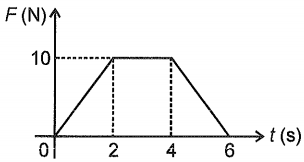
The force (F) acting on a particle varies with the time (t) as shown in the figure. The change in momentum during t = 0 to t = 6 s is:
(1) 80 Ns
(2) 40 Ns
(3) 20 Ns
(4) Zero
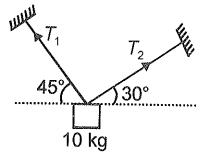
A body of mass 10 kg is suspended by two massless strings making angles 45° and 30° with horizontal as shown in the figure then:
(1)
(2)
(3)
(4)
Two masses, \(M\) and \(m\), are connected by a weightless string. They are pulled by a force on a frictionless horizontal surface. The tension in the string will be:
1. \(\dfrac{F \left(M + 2 m\right)}{m + M}\)
2. \(\dfrac{F}{m+M}\)
3. \(\dfrac{FM}{m}\)
4. \(\dfrac{Fm}{m+M}\)
An impulse of \(6m \hat{j}\) is applied to a body of mass m moving with velocity \(\hat i+2\hat j\). The final velocity of the body will be:
1. \(-\hat i + 8\hat j\)
2. \(\hat i - 8\hat j\)
3. \(\hat i + 8\hat j\)
4. \(8\hat i - \hat j\)
According to Newton's second law of motion force acting on the body is:
[where symbols have their usual meaning]
(1)
(2)
(3)
(4) All of these
Which of the following is/are an example/s of impulse?
(1) Hitting off the ball on the ground and bouncing back
(2) When a batsman hits the ball
(3) When a ball falls into the net
(4) All of these
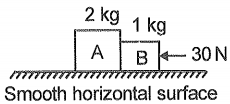
In the given figure, the acceleration of block A (of mass 2 kg) is:
(1) 2
(2) 15
(3) 10
(4) 0.1
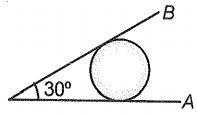
A sphere weighs 10 N and rests in a V-shaped trough whose sides form an angle . Normal reaction exerted by wall B on the sphere is:
(1) 10 N
(2) 53 N
(3) 5 N
(4) Zero
Fundamentally, the normal force between two surfaces in contact is:
1. Electromagnetic
2. Gravitational
3. Weak nuclear force
4. Strong nuclear force
Choose the incorrect alternative:
| 1. | Newton's first law is the law of inertia. |
| 2. | Newton's first law states that if the net force on a system is zero, the acceleration of any particle of the system is not zero. |
| 3. | Action and reaction act simultaneously. |
| 4. | The area under the force-time graph is equal to the change in momentum. |
If two forces \(\left(6 \hat{i}+8\hat j\right)\) and \(\left(4 \hat{i}+4\hat j \right)\)N are acting on a body of mass \(2\) kg, then the acceleration produced in the body (in \(\text{m/s}^{2}\)) will be:
1. \(\left(5 \hat{i}+6\hat j\right)\)
2. \(\left(10 \hat{i}+12\hat j\right)\)
3. \(\left(6 \hat{i}+12\hat j\right)\)
4. \(\left(2 \hat{i}+3\hat j\right)\)
The speed of a 5 kg body is reduced from 65 m/s to 15 m/s in 2 s. The average resisting force acting is:
(1) 125 N
(2) 1250 N
(3) 12.5 N
(4) 200 N
A block of mass \(M\) is pulled by a force \(F\), making an angle \(\theta\) with the horizontal on a smooth horizontal surface as shown. If \(a\) is the acceleration of block on the surface, then the contact force between the block and the surface will be:
1. \(Mg+ Ma\cos\theta\)
2. \(Mg- Ma\cos\theta\)
3. \(Mg+ Ma\tan\theta\)
4. \(Mg- Ma\tan\theta\)
A machine gun fires a bullet of mass 50 g with a velocity of 1000 m/s. The man holding it can exert a maximum force of 160 N on the gun. How many bullets can he fire per second at the most?
(1) 3
(2) 4
(3) 2
(4) 5
If block A as shown in the figure is pushed horizontally by a horizontal force 20 N, then the force exerted by A on B is:
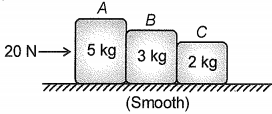
(1) 4 N
(2) 8 N
(3) 10 N
(4) 20 N
If the force acting on a system is zero, the quantity which remains constant is:
| 1. | Force | 2. | Linear momentum |
| 3. | Speed | 4. | Kinetic energy |

