 Laws of Motion: Part 2 (Friction + Circular Motion + Spring)Contact Number: 8527521718Laws of Motion: Part 2 (Friction + Circular Motion + Spring)Contact Number: 8527521718
A mass of 5 kg is placed on a horizontal rough surface. The coefficient of friction between body and surface is 0.5. The minimum horizontal force with which the block will just be able to move is: [Take g = ]
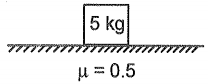
(1) 25 N
(2) N
(3) 50 N
(4) 22.5 N
What is the value of friction acting on the block kept at rest on the inclined surface? [Take g = 10 )
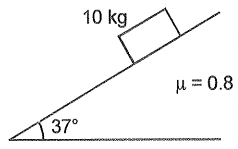
1. 60 N
2. 64 N
3. 80 N
4. 100 N
Two blocks of masses \(2\) kg and \(3\) kg placed on a horizontal surface are connected by a massless string. If \(3~\text{kg}\) is pulled by \(10\) N as shown in the figure, then the force of friction acting on the \(2~\text{kg}\) block will be:
(Take \(g=10~\text{m/s}^2\))

| 1. | \(6~\text N\) | 2. | \(4~\text N\) |
| 3. | \(8~\text N\) | 4. | \(12~\text N\) |
Mark the correct statement:
1. The value of the coefficient of friction is always smaller than 1.
2. A body slides on a surface, the force of friction always acts in the opposite direction of applied force.
3. Force of friction is zero for a block kept on a rough inclined plane.
4. The frictional force can never be more than the contact force on the body from the surface on which it is kept.
If the system shown in the figure is in equilibrium, then the reading of spring balance (in kgf) is:
1. \(10\)
2. \(20\)
3. \(100\)
4. zero
The contact force between surface and mass in the given figure is: (g = 10 m/)
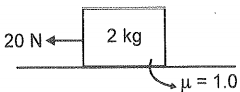
1. 20 N
2. 20N
3. 30 N
4. Zero
The parallel component of the contact force is called:
1. Normal reaction
2. Weight
3. Mechanical force
4. Friction
The block of mass m (shown in the figure) does not move on applying the inclined force \(F\). The friction force acting on the block is:
1. \(F \cos\theta\)
2. \(F \sin\theta\)
3. \(\mu mg-F \sin\theta\)
4. \(\mu mg\)
A particle of mass \(m\) is suspended from a ceiling through a massless string. The particle moves in a horizontal circle as shown in the given figure. The tension in the string is:

1. \(mg\)
2. \(2mg\)
3. \(3mg\)
4. \(4mg\)
For what minimum value of the horizontal force F, the block kept on the rough horizontal surface will start moving? (g = 10 m/)
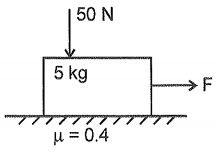
1. 20 N
2. 30 N
3. 40 N
4. 60 N
A block of mass 5 kg is placed on a rough horizontal plane. A time-dependent horizontal force F = ( + 2t) N acts on the block. The friction force between the block and the plane at t =3 s is: ( = 0.4)
1. 8 N
2. 15 N
3. 20 N
4. Zero
The friction between the front foot and the back foot when walking on a horizontal surface is, respectively:
1. Forward, forward
2. Backward, backward
3. Forward, backward
4. Backward, forward
The strings and pulleys shown in the figure are massless. The reading shown by the light spring balance is:
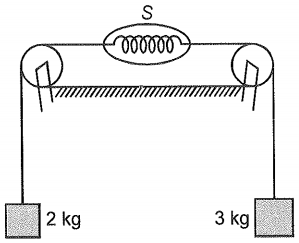
1. 2.4 kg
2. 5 kg
3. 2.5 kg
4. 3 kg
The length of a spring is and when stretched with a force of 4 N and 5 N respectively. Its natural length is:
1. +
2. 2( - )
3. 5 - 4
4. 5 - 4
A body of mass \(m\) is moving on a concave bridge \(ABC\) of the radius of curvature \(R\) at a speed \(v.\) The normal reaction of the bridge on the body at the instant it is at the lowest point of the bridge is:
1. \(mg-\frac{mv^{2}}{R}\)
2. \(mg+\frac{mv^{2}}{R}\)
3. \(mg\)
4. \(\frac{mv^{2}}{R}\)
Which of the following is correct about friction?
| 1. | Sliding friction is self-adjusting.
|
| 2. | Static friction is self-adjusting.
|
| 3. | Kinetic friction is more than static friction.
|
| 4. | Static friction is independent of driving force. |
Two blocks, \(A\) and \(B\), of masses \(2m\) and \(4m\) are connected by a string. The block of mass \(4m\) is connected by a spring (massless). The string is suddenly cut. The ratio of the magnitudes of accelerations of masses \(2m\) and \(4m\) at that instant will be:
| 1. | \(1:2\) | 2. | \(2:1\) |
| 3. | \(1:4\) | 4. | \(4:1\) |
The reading of spring balance in the depicted figure will be:
| 1. | \(0\) N | 2. | \(20\) N |
| 3. | \(10\) N | 4. | \(5\) N |
The angle of banking for a cyclist taking a turn at a curve is given by \(\tan\theta = \frac{v^{n}}{rg}\) where symbols have their usual meaning. The value of \(n\) is:
| 1. | \(1\)
|
2. | \(2\)
|
| 3. | \(3\)
|
4. | \(4\) |
| 1. | \(36\) km/h | 2. | \(54\) km/h |
| 3. | \(72\) km/h | 4. | \(90\) km/h |


