 Anatomy of Flowering PlantsContact Number: 8527521718Anatomy of Flowering PlantsContact Number: 8527521718
Select incorrect statement with respect to anatomical features of monocot root.
| 1. | Pericycle produces lateral roots and part of vascular cambium |
| 2. | Exodermis is present in older roots |
| 3. | Conjunctive parenchyma does not produce cambium |
| 4. | Well developed pith is present |
In the life cycle of a plant, the secondary tissues are made by
1. Intercalary meristem and vascular cambium
2. Apical meristem and cork cambium
3. Cork-cambium and vascular cambium
4. Primary meristems and interfascicular cambium
Casparian strips are present in the endodermis of
| 1. | Monocot stem |
| 2. | Dicot root |
| 3. | Dicot stem |
| 4. | More than one option is correct |
Mark the correct one with respect to bundle sheath in a dicot leaf
| 1. | Sclerenchymatous | 2. | Collenchymatous |
| 3. | Parenchymatous | 4. | Lignified |
The springwood present in an annual ring
1. Is dark colored
2. Has high density than autumn wood
3. Has abundant fibers
4. Has low density than autumn wood
Bulliform cells are associated with
| 1. | The epidermis of dorsiventral leaves |
| 2. | The adaxial epidermis of isobilateral leaves |
| 3. | The abaxial epidermis of monocot leaves |
| 4. | Mesophylls of dicot leaves |
In monocotyledonous stem
| 1. | Hypodermis is parenchymatous |
| 2. | Each vascular bundle is surrounded by collenchymatous bundle sheath |
| 3. | Peripheral vascular bundles are generally larger than centrally located ones |
| 4. | Water containing cavities are present within the vascular bundles |
A tree can be killed by removing its bark, as this also removes the ________.
| 1. | Phelloderm only | 2. | Phellem only |
| 3. | Primary xylem | 4. | Secondary phloem |
Choose odd with respect to collenchyma
| 1. | Living mechanical tissue |
| 2. | Intercellular space is absent in angular type |
| 3. | Thickening of the wall is due to deposition of lignin |
| 4. | Found in hypodermis of dicot stem |
Select incorrect statements from the given below:
| (i) | Endodermis with Casparian strips are found in the dicot stem. |
| (ii) | The endodermis is a part of the stele. |
| (iii) | Open vascular bundles are found in some monocots. |
| (iv) | Bulliform cells are found in the upper epidermis in the isobilateral leaf. |
| 1. | (i) and (ii) |
| 2. | (ii) and (iii) |
| 3. | (i), (ii) and (iii) |
| 4. | Only (iv) |
Dicot roots do not have cambium in vascular bundles, but secondary growth cambium is served from
1. Pericycle cells only
2. Pericycle and conjunctive tissue
3. Conjunctive tissue only
4. Pericycle and cortex
Which of the following is secondary in origin?
1. Phellogen
2. Interfascicular cambium
3. Wound meristem
4. More than one option is correct
Periderm includes
| 1. | Only cork cambium |
| 2. | Cork cambium and cork only |
| 3. | Cork and secondary cortex |
| 4. | Cork, Cork cambium and secondary cortex |
Select incorrect statement with respect to the anatomy of monocot stem
| 1. | Parenchymatous ground tissue is extended from the bottom of hypodermis to center |
| 2. | Hypodermis is made of thick-walled living mechanical tissue |
| 3. | Vascular bundles are conjoint, collateral and closed with endarch xylem |
| 4. | Pith is absent |
In parenchyma, all cells are isodiametric and
| 1. | Thin-walled |
| 2. | Thick-walled |
| 3. | Lignified-walled |
| 4. | Devoid of intercellular spaces |
In which character an isobilateral leaf differs from the dorsiventral leaf?
| 1. | Scattered vascular bundles |
| 2. | Undifferentiated mesophylls |
| 3. | Absence of stomata with guard cells |
| 4. | Conjoint, collateral, and closed vascular bundle |
Tissue which provides mechanical strength and flexibility to young dicot stem is present in
| 1. | Pith | 2. | Endodermis |
| 3. | Hypodermis | 4. | Cortex |
The ground tissue system is constituted by all off these, except
| 1. | Medullary rays | 2. | Pericycle |
| 3. | Mesophyll | 4. | Xylem |
Conjoint, collateral, closed vascular bundles without phloem parenchyma are found in plants which have
| 1. | Differentiated ground tissue in the stem |
| 2. | Dedifferentiated pericyclic structure in the mature root |
| 3. | Sclerenchymatous hypodermis in stem |
| 4. | Developed pith in stem |
The tissue belonging to bark but not to periderm is
1. Vascular cambium
2. Secondary phloem
3. Phellem
4. Secondary cortex
Which of the following is correct with respect to lenticels?
| a. | Phellogen forms parenchymatous cells on the outer side |
| b. | It is a lens-shaped opening |
| c. | Helps in exchange of gases |
| d. | Present mostly in woody trees |
1. a & b correct
2. c & d correct
3. b, c, & d correct
4. All are correct
Identify the incorrect match with respect to wood characters given in A, B, C column
A B C
| 1. | Early Wood | Large no. of xylary elements |
Springwood | wide cavities |
| 2. | Latewood | Few xylary elements |
Autumn wood | Narrow cavities |
| 3. | Heartwood | Dark brown in Colour |
Dead elements | Filled with resins and gums |
| 4. | Sapwood | Light in color | Living elements | Conducts minerals only. |
In a leaf, oval cells with large intercellular spaces and radially arranged columnar cells without intercellular spaces are placed respectively towards
| 1. | Adaxial and abaxial epidermis |
| 2. | Abaxial and adaxial epidermis |
| 3. | Abaxial and abaxial epidermis |
| 4. | Lower and abaxial epidermis |
Select the incorrect statement with respect to late wood
1. It forms a narrow strip in annual rings
2. Has smaller and narrower vessels
3. Darker in colour
4. Fibres are less
Which of the following is not the component of secondary phloem?
| 1. | Protophloem | 2. | Bast fibers |
| 3. | Companion cells | 4. | Phloem parenchyma |
Monocot root differs from dicot root in
| 1. | Having differentiated ground tissue |
| 2. | Presence of centripetal xylem |
| 3. | Pericyclic origin of lateral roots |
| 4. | Presence of large and well-developed pith |
Protoxylem lies towards periphery and metaxylem lies towards the centre. Such arrangement of ______ xylem is present in ________.
1. Secondary, root
2. Primary, stem
3. Secondary, stem
4. Primary, root
Which one of the following are elongated single-celled water-conducting dead structures with bordered pits?
| 1. | Tracheids | 2. | Vessels |
| 3. | Sclerenchyma fibres | 4. | Sclereids |
Lenticels are present in
1. Outer primary protective tissue
2. The outer layer of secondary protective tissue
3. The middle layer of secondary protective tissue
4. Inner layer of secondary protective tissue
Cells having cellulose, hemicellulose and pectin deposits on the wall and shows its presence commonly in the petiole of leaf and growing green stems belong to
1. Sclerenchyma
2. Collenchyma
3. Aerenchyma
4. Parencyma
Elongated or tube-like cells with thick and lignified walls and tapering ends is
1. Tracheids
2. Vessel
3. Sieve tube
4. Collenchyma
As compared to the monocot root, the dicot root has/shows
| 1. | Large and well-developed pith |
| 2. | Primary growth only |
| 3. | Sclerenchymatous pericycle |
| 4. | Fewer xylem bundles |
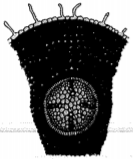
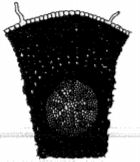
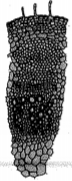
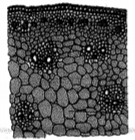
Which of the given figure represents the internal structural details of a monocot root?
1. 
2. 
3. 
4. 
The most abundant and common tissue in plants
| 1. | Has non-vacuolated cytoplasm |
| 2. | Is living and has cellulosic wall |
| 3. | Stores ergastic substances always |
| 4. | Cannot take part in photosynthesis |
Secondary meristems are found in
1. All angiosperms
2. Gymnosperms and all monocots
3.Dictos and gymnosperms
4. All spermatophytes
Monocot stems do not have
| 1. | Protophloem |
| 2. | Phloem parenchyma |
| 3. | Companion cell in phloem |
| 4. | Sieve tube and metaphloem |
Choose the correct option with respect to sclereids
| 1. | Physiologically active |
| 2. | Pits are present |
| 3. | Derived from meristems directly |
| 4. | Little amount of protoplasm is present |
The isobilateral leaf is characterized by all the given characteristics, except
| 1. | Vascular bundles are always closed |
| 2. | Xylem is towards the adaxial surface of leaf |
| 3. | Mesophyll cells are not differentiated |
| 4. | Parenchymatous extensions of the bundle sheath |
Collenchyma is characterised by
| 1. | Absence of protoplast at maturity |
| 2. | Supporting young stem and leaf petiole |
| 3. | Lignocellulosic thickening on secondary walls |
| 4. | The common presence of intracellular spaces |
Epidermal hairs on stems known as trichomes
| 1. | May sometimes be secretory in function |
| 2. | Have vascular supply |
| 3. | May be soft or stiff but unbranched always |
| 4. | Are endogenous in origin like lateral roots |
Select the incorrect statement with respect to bast fibres
| a. | Generally absent in primary phloem |
| b. | Elongated, branched with blunt ends |
| c. | Parenchymatous in nature |
| d. | Becomes dead at maturity |
1. a & d
2. b & d
3. b & c
4. a & b
Sieve tube elements are long, tube-like structures, arranged longitudinally and associated with the companion cells. A mature sieve element
| 1. | Has a small vacuole |
| 2. | Lacks nucleus and cytoplasm |
| 3. | Possesses a large vacuole and small nucleus |
| 4. | Possesses a peripheral cytoplasm |
During the secondary growth in the dicot stem, the cambial ring becomes active and begins to cut off new cells both towards the inner and the outer sides. The cells cut off
1. Towards pith, mature into secondary phloem
2. Towards the periphery, mature into secondary xylem
3. Towards pericycle, mature into secondary xylem as well as secondary phloem
4. Mature into secondary vascular tissues
Match the column I with column II
| Column I | Column II | ||
| a. | Xylem parenchyma | (i) | Absent in most of the monocots |
| b. | Sclereids | (ii) | Lond cylindrical tube-like structure |
| c. | Phloem parenchyma | (iii) | Food and tannins |
| d. | Vessel | (iv) | Fruit walls of nuts |
1. a(i), b(ii), c(iii), d(iv)
2. a(ii), b(iv), c(iii), d(i)
3. a(iii), b(iv), c(i), d(ii)
4. a(iii), b(ii), c(i), d(iv)
Mark the incorrect statement with respect to guard cells in stomata
| 1. | In grasses these are dumb-bell shaped |
| 2. | They possess chloroplasts |
| 3. | Regulate opening and closing of stomata |
| 4. | Outer walls are thick and inner walls are thin in dicots |
Well developed pith is present in
1. Dicot stem, monocot root
2. Monocot stem, dicot root
3. Dicot root, dicot stem
4. Monocot root, monocot stem
Which among the following cannot be a feature of given diagram?
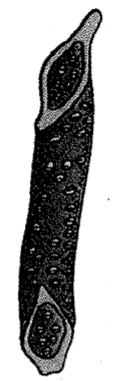
| 1. | It is a long cylindrical tube like structure |
| 2. | Having lignified walls |
| 3. | having large central cavity |
| 4. | Having protoplasm |
Mark the correct statements with respect to meristematic tissues
| A. | The meristem that occurs at the tip of roots and shoots contributes to the formation of the primary plant body. |
| B. | The lateral meristems are responsible for producing the secondary tissues. |
| C. | Some cells 'left behind' from the lateral meristem, constitute the axillary bud. |
| D. | The cells which are structurally and functionally specialised and lose the ability to divide are called meristems. |
| 1. | A & C | 2. | A & B |
| 3. | B & C | 4. | C & D |