 Systems of Particles and Rotational Motion Part 1: Centre of Mass, Moment of Inertia & Angular VariablesContact Number: 8527521718Systems of Particles and Rotational Motion Part 1: Centre of Mass, Moment of Inertia & Angular VariablesContact Number: 8527521718
If a particle moves in a circle with a constant angular speed \((\omega)\) about the point \(O,\) then its angular speed about the point \(A\) will be:

1. \(2\omega\)
2. \(\dfrac{\omega}{2}\)
3. \(\omega\)
4. \(\dfrac{\omega}{4}\)
In the three figures, each wire has a mass M, radius R and a uniform mass distribution. If they form part of a circle of radius R, then about an axis perpendicular to the plane and passing through the centre (shown by crosses), their moment of inertia is in the order:
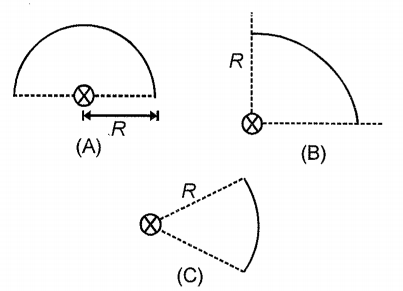
1.
2.
3.
4.
Particles \(A\) and \(B\) are separated by \(10~\text m,\) as shown in the figure. If \(A\) is at rest and \(B\) started moving with a speed of \(20~\text{m/s}\) then the angular velocity of \(B\) with respect to \(A\) at that instant is:

| 1. | \(1~\text{rad/s}\) | 2. | \(1.5~\text{rad/s}\) |
| 3. | \(2~\text{rad/s}\) | 4. | \(2.5~\text{rad/s}\) |
Moment of inertia of a semicircular disc of radius R and mass m about XY lying in the plane of the disc as shown in the figure is: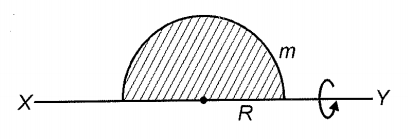
1.
2.
3.
4.
The moment of inertia of a uniform ring about an axis tangent to the ring and normal to its plane is I. Its moment of inertia about the diameter is:
1.
2.
3.
4.
A monkey is hanging on the rope of a balloon in the air. Both the monkey and balloon are at rest in mid-air. If the monkey climbs up the rope, then:
1. the balloon rises up.
2. the balloon comes down.
3. the centre of mass of the balloon and monkey system falls down.
4. the centre of mass of the balloon and monkey system rises up.
A bomb is projected from the ground at a horizontal range of \(R\). If the bomb explodes mid-air, then the range of its centre of mass is:
1. \(\frac{R}{2}\)
2. \(R\)
3. \(2R\)
4. \(\frac{2R}{3}\)
The moment of inertia of a uniform rod about its perpendicular bisector is I. Its moment of inertia about an axis normal to it and passing through one end is:
1. I
2. 3I
3. 4I
4. 12I
A particle rotating on a circular path of the radius \(\frac{4}{\pi}~\text{m}\) at \(300\) rpm reaches \(600\) rpm in \(6\) revolutions. If the angular velocity increases at a constant rate, find the tangential acceleration of the particle:
1. \(10\) m/s2
2. \(12.5\) m/s2
3. \(25\) m/s2
4. \(50\) m/s2
Consider a system of two identical particles. One of the particles is at rest and the other has an acceleration a. The centre of mass has an acceleration:
1. zero
2.
3. a
4. 2a

| 1. | \(2ml^2\) | 2. | \(4ml^2\) |
| 3. | \(3ml^2\) | 4. | \(ml^2\) |
Mass of bigger disc having radius 2R is M. A disc of radius R is cut from the bigger disc as shown in the figure. Moment of inertia of remaining disc about an axis passing through periphery and perpendicular to plane (shown in the figure) is: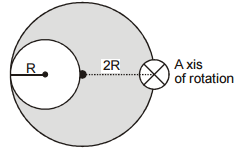
1.
2.
3.
4.
The mass per unit length of a non-uniform rod of length \(L\) is given by \(\mu =λx^{2}\) where \(\lambda\) is a constant and \(x\) is the distance from one end of the rod. The distance between the centre of mass of the rod and this end is:
| 1. | \(\frac{L}{2}\) | 2. | \(\frac{L}{4}\) |
| 3. | \(\frac{3L}{4}\) | 4. | \(\frac{L}{3}\) |
A wheel was at rest. Its angular velocity increases uniformly and becomes 80 radians per second after 5 seconds. Its total angular displacement is:
1. 800 rad
2. 400 rad
3. 200 rad
4. 100 rad
At \(t=0,\) the positions of the two blocks are shown. There is no external force acting on the system. Find the coordinates of the centre of mass of the system (in SI units) at \(t=3\) seconds.

| 1. | \((1,0)\) | 2. | \((3,0)\) |
| 3. | \((4.5,0)\) | 4. | \((2.25,0)\) |
Two gear wheels that are meshed together have radii of 0.50 cm and 0.15 cm. The number of revolutions made by the smaller one when the larger one goes through 3 revolutions is:
1. 5 revolutions
2. 20 revolutions
3. 1 revolution
4. 10 revolutions
The angular speed of the wheel of a vehicle is increased from 360 rpm to 1200 rpm in 14 seconds. Its angular acceleration is:
(1) 2 rad/
(2) 28 rad/
(3) 120 rad/
(4) rad/
Three identical spheres, each of mass \(M\), are placed at the corners of a right-angle triangle with mutually perpendicular sides equal to \(2~\text{m}\) (see figure). Taking the point of intersection of the two mutually perpendicular sides as the origin, find the position vector of the centre of mass.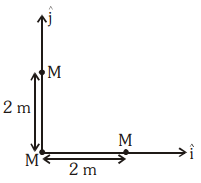
| 1. | \(2( \hat{i}+ \hat{j})\) | 2. | \(( \hat{i}+ \hat{j})\) |
| 3. | \({2 \over 3}( \hat{i}+ \hat{j})\) | 4. | \({4 \over 3}( \hat{i}+ \hat{j})\) |