 Mathematical Tools - Live Session - 26 May 2020Contact Number: 8527521718Mathematical Tools - Live Session - 26 May 2020Contact Number: 8527521718
If the angle between the vector is , the value of the product is equal to:
1.
2.
3.
4. zero
Two forces are such that the sum of their magnitudes is \(18~\text{N}\) and their resultant is perpendicular to the smaller force and the magnitude of the resultant is \(12~\text{N}\). Then the magnitudes of the forces will be:
1. \(12~\text{N}, 6~\text{N}\)
2. \(13~\text{N}, 5~\text{N}\)
3. \(10~\text{N}, 8~\text{N}\)
4. \(16~\text{N}, 2~\text{N}\)
If the magnitude of the sum of two vectors is equal to the magnitude of the difference between the two vectors, the angle between these vectors is:
1. \(90^{\circ}\)
2. \(45^{\circ}\)
3. \(180^{\circ}\)
4. \(0^{\circ}\)
The resultant of two vectors A and B is perpendicular to the vector A and its magnitude is equal to half the magnitude of vector B. The angle between A and B is -
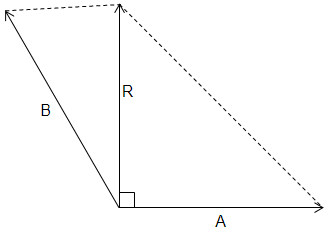
1.
2.
3.
4. None of these
What is the resultant of three coplanar forces: at , at and at ?
1.
2.
3.
4.
For the figure -
1. A+B=C
2. B+C=A
3. C+A=B
4. A+B+C=0
The two vectors and are -
1. parallel
2. perpendicular
3. anti-parallel
4. None of these
A vector A points, vertically upward and, B points towards north. The vector product is -
1. along west
2. along east
3. zero
4. vertically downward
The vector having a magnitude of 10 and perpendicular to the vector is-
1.
2.
3.
4.
If \(\overrightarrow{A}={2}\hat{i}+\hat{j}\;{\&}\;\overrightarrow{B}=\hat{i}{-}\hat{j},\) then the components of \(\overrightarrow {A}\) along with \(\overrightarrow {B}\) & perpendicular to \(\overrightarrow {B}\) respectively will be:
1. \(\frac{\hat{i} - \hat{j}}{2} ,~\frac{3}{2}\left(\hat i+\hat j\right)\)
2. \(\frac{\hat{i} - \hat{j}}{2} ,~-\frac{2}{3}\left(\hat i+\hat j\right)\)
3. \(\frac{\hat{i} - \hat{j}}{2} ,~-\frac{3}{2}\left(\hat i-\hat j\right)\)
4. \(\frac{\hat{i} - \hat{j}}{2} ,~\frac{2}{3}\left(\hat i-\hat j\right)\)
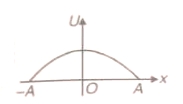
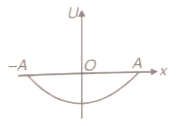
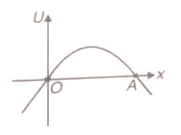
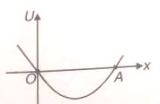
Which of the following represented to \(U-x\) graph of \(U=\dfrac{1}{2} K \left(\right. A^{2} - x^{2} \left.\right) ? \left(\right. K > 0 \left.\right)\)
1. 
2. 
3. 
4. 
If curve between acceleration () and position (x) is a straight line as shown. Then acceleration is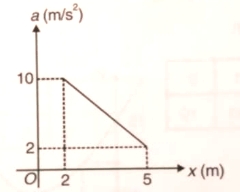
Which of the following graphs best represents the straight line \(y=-2x+5\text{?}~\)
| 1. |  |
2. |  |
| 3. |  |
4. |  |
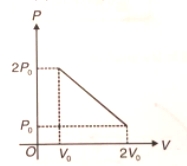
1. \(2P_0 - \frac{P_0V}{V_0}\)
2. \(3P_0 - \frac{P_0V}{V_0}\)
3. \(P_0 - \frac{P_0V}{V_0}\)
4. \(4P_0 - \frac{P_0V}{V_0}\)
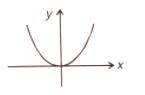
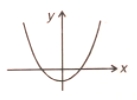
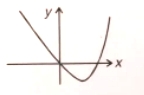
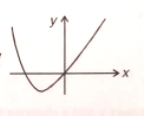
The parabola y = x + 2x is represented by
1. 
2. 
3. 
4. 
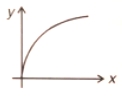
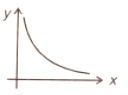
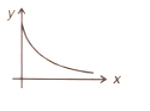
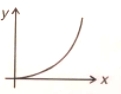
The relationship y = is best represented as
1. 
2. 
3. 
4. 
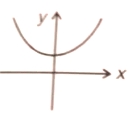
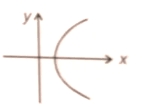
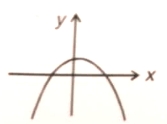
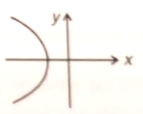
The parabola y = x + 1 is represented by
1. 
2. 
3. 
4. 
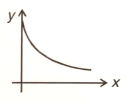
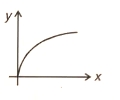
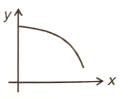
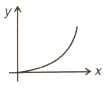
The slope of a curve between y and x changes from 0 to -5 as x changes from 0 to 5. Which of the following curve best represents the above mentioned curve?
1. 
2. 
3. 
4. 
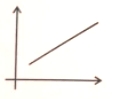
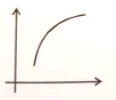
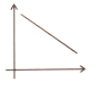
Which of the following graph has a positive, decreasing slope?
1. 
2. 
3. 
4. 
The slope of a curve is initially positive, then becomes zero, and thereafter becomes negative. Which of the following graphs best represents this behaviour?
| 1. |  |
2. |  |
| 3. |  |
4. |  |
