 Motion in a Plane (Projectile & Circular Motion)Contact Number: 8527521718Motion in a Plane (Projectile & Circular Motion)Contact Number: 8527521718
The angle of projection at which the horizontal range and maximum height of projectile are equal is:
(1) 45°
(2)
(3)
(4) 60°
A projectile is fired from the surface of the earth with a velocity of 5 m/s and angle with the horizontal. Another projectile fired from another planet with a velocity of 3 m/s at the same angle follows a trajectory, which is identical to the trajectory of the projectile fired from the earth. The value of the acceleration due to gravity on the planet (in m/s2) is: [Given, g = 9.8 m/s2]
1. 3.5
2. 5.9
3. 16.3
4. 110.8
The velocity of a projectile at the initial point \(A\) is \(2\hat i+3\hat j~\text{m/s}.\) Its velocity (in m/s) at the point \(B\) is:
| 1. | \(-2\hat i+3\hat j~\) | 2. | \(2\hat i-3\hat j~\) |
| 3. | \(2\hat i+3\hat j~\) | 4. | \(-2\hat i-3\hat j~\) |
An aeroplane is flying horizontally with a velocity u = 600 km/h at a height of 1960 m. When it is vertically at a point A on the ground, a bomb is released from it. The bomb strikes the ground at point B. The distance AB is:
1. 1200 m
2. 0.33 km
3. 3.33 km
4. 33 km
A cannon ball has the same range R on a horizontal plane for two different angles of projection. If are the greatest height in the two paths for which this is possible, then:
1.
2.
3.
4.
A projectile is projected with initial kinetic energy \(K\). If it has kinetic energy \(0.25K\) at its highest point, then the angle of projection is:
1. \(30^{\circ}\)
2. \(45^{\circ}\)
3. \(60^{\circ}\)
4. \(75^{\circ}\)
A cricketer can throw a ball to a maximum horizontal distance of 100 m. How much high above the ground can the cricketer throw the same ball?
1. 40 m
2. 45 m
3. 500 m
4. 50 m
The equation of motion of a projectile is given by x = 36 t metre and 2y = 96 t – 9.8 t2 metre. The angle of projection is:
1.
2.
3.
4.
Three balls are thrown from the top of a building with equal speeds at different angles. When the balls strike the ground, their speeds are \(v_{1} , v_{2}\) \(\text{and}\) \(v_{3}\) respectively, then:

1. \(v_{1} > v_{2} > v_{3}\)
2. \(v_{3} > v_{2} = v_{1}\)
3. \(v_{1} = v_{2} = v_{3}\)
4. \(v_{1} < v_{2} < v_{3}\)
The position vector of a particle as a function of time is given by r = 4sin(2t)+ 4cos(2t) where r is in metre, t is in seconds, and denote unit vectors along x and y-directions, respectively. Which one of the following statements is wrong for the motion of particle?
1. Acceleration is along
2. Magnitude of the acceleration vector is v2/R where v is the velocity of the particle
3. Magnitude of the velocity of the particle is 8 m/s
4. Path of the particle is a circle of radius 4 m
If a particle is moving in a circular orbit with constant speed, then:
| 1. | its velocity is variable. |
| 2. | its acceleration is variable. |
| 3. | its angular momentum is constant. |
| 4. | All of the above |
In the given figure, \(a=15\) m/s2 represents the total acceleration of a particle moving in the clockwise direction in a circle of radius \(R=2.5\) m at a given instant of time. The speed of the particle is:
1. \(4.5\) m/s
2. \(5.0\) m/s
3. \(5.7\) m/s
4. \(6.2\) m/s
A particle moves with constant speed \(v\) along a circular path of radius \(r\) and completes the circle in time \(T\). The acceleration of the particle is:
1. \(2\pi v / T\)
2. \(2\pi r / T\)
3. \(2\pi r^2 / T\)
4. \(2\pi v^2 / T\)
Which of the following can be the angle between velocity and acceleration of a particle in a circular motion with increasing speed?
(1) 30°
(2) 90°
(3) 120°
(4) 0°
If the equation for the displacement of a particle moving on a circular path is given by \(\theta = 2t^3 + 0.5\) where \(\theta\) is in radians and \(t\) in seconds, then the angular velocity of the particle after \(2\) sec from its start is:
1. \(8\) rad/sec
2. \(12\) rad/sec
3. \(24\) rad/sec
4. \(36\) rad/sec
A car moves on a circular path such that its speed is given by \(v= Kt\), where \(K\) = constant and \(t\) is time. Also given: radius of the circular path is \(r\). The net acceleration of the car at time \(t\) will be:
1. \(\sqrt{K^{2} +\left(\frac{K^{2} t^{2}}{r}\right)^{2}}\)
2. \(2K\)
3. \(K\)
4. \(\sqrt{K^{2} + K^{2} t^{2}}\)
A particle is moving with speed v on a circle (of radius r and centred at the origin) as shown in the given figure in anticlockwise fashion. The average acceleration of the particle during its motion from point A to point B is:
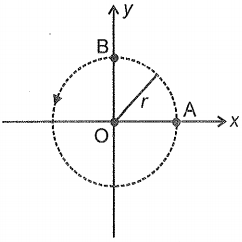
1.
2.
3.
4.
At a certain moment, the angle between the velocity vector and the acceleration of a particle is greater than 90°. What can be inferred about its motion at that moment?
(1) It moves along a curve and its speed is decreasing.
(2) It moves along a straight line and accelerated.
(3) It moves along a curve and its speed is increasing.
(4) It moves along a straight line and it is decelerated.
A particle is moving on a circular path of radius 1 m with a speed of 10 m/s. The magnitude of change in its velocity in the interval it subtends an angle 60° at the center is:
1. 10 m/s
2. 20 m/s
3. m/s
4. Zero

