 Motion in a Plane (Relative Motion)Contact Number: 8527521718Motion in a Plane (Relative Motion)Contact Number: 8527521718
Wind blowing from South at 10 m/s but to a cyclist, it appears to be blowing from the East at 10 m/s. The cyclist has a velocity:
Rain is falling vertically with a speed of 30 . A woman rides a bicycle at a speed of 10 in the north to south direction. What is the direction with vertical in which she should hold her umbrella?
(1)
(2)
(3)
(4)
The speed of water in a river is \(4\) km/h and a man can swim at \(5\) km/h. The minimum time taken by the man to cross the river of width \(200\) m is:
1. \(\frac{1}{5}~\text{h}\)
2. \(\frac{1}{25}~\text{h}\)
3. \(\frac{1}{15}~\text{h}\)
4. \(\frac{1}{20}~\text{h}\)
A bus is going to the North at a speed of \(30\) kmph. It makes a \(90^{\circ}\) left turn without changing the speed. The change in the velocity of the bus is:
| 1. | \(30~\text{kmph}\) towards \(\mathrm{W}\) |
| 2. | \(30~\text{kmph}\) towards \(\mathrm{S\text-W}\) |
| 3. | \(42.4~\text{kmph}\) towards \(\mathrm{S\text-W}\) |
| 4. | \(42.4~\text{kmph}\) towards \(\mathrm{N\text-W}\) |
A swimmer swims a distance d upstream in 4 s and swims an equal distance downstream in 2 s. The ratio of swimmer's speed in still water to the speed of river water will be:
1.
2.
3.
4.
A boat is moving with a velocity with respect to the river. If the boat reaches the exact opposite point on the other shore, then which of the following options is possible for the velocity of the river?
1.
2.
3.
4.
A man runs along a horizontal road holding his umbrella vertical in order to afford maximum protection from the rain. The rain is actually:
1. Falling vertical
2. Coming from front of the man
3. Coming from the back of the man
4. Either of (1), (2), or (3)
A man is crossing a river flowing with the velocity of 5 m/s. He reaches a point directly across at a distance of 60 m in 5 sec. His velocity in still water should be: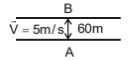
1. 12 m/s
2. 13 m/s
3. 5 m/s
4. 10 m/s
The speed of a swimmer in still water is 20 m/s. The speed of river water is 10 m/s and is flowing due east. If he is standing on the south bank and wishes to cross the river along the shortest path, the angle at which he should make his strokes with respect to north is given by:
1. 45 west
2. 30 west
3. 0
4. 60 west
A car is moving along east at \(10\) m/s and a bus is moving along north at \(10\) m/s. The velocity of the car with respect to the bus is along:
| 1. | North-East | 2. | South-East |
| 3. | North-West | 4. | South-West |
A boat moves with a speed of 5 km/h relative to water in a river flowing with a speed of 3 km/h and having a width of 1 km. The minimum time taken around a round trip(returning to the initial point) is:
1. 5 min
2. 60 min
3. 20 min
4. 30 min
A man standing on a road holds his umbrella at 30° with the vertical to keep the rain away. He throws the umbrella and starts running at 10 km/hr. He finds that raindrops are hitting his head vertically, the speed of raindrops with respect to the road will be:
1. 10 km/hr
2. 20 km/hr
3. 30 km/hr
4. 40 km/hr
A boat is moving with velocity of in river and water is moving with a velocity of with respect to ground. Relative velocity of boat with respect to water is:
1.
2.
3.
4.
A steam boat goes across a lake and comes back (a) On a quiet day when the water is still and (b) On a rough day when there is a uniform air current so as to help the journey onward and to impede the journey back. If the speed of the launch on both the days was the same, in which case will the steam boat complete the journey in lesser time:
| 1. | Case (a) |
| 2. | Case (b) |
| 3. | Same in both case |
| 4. | Nothing can be predicted based on given data |
A man can row a boat with a speed of \(10~\text{kmph}\) in still water. The river flows at \(6~\text{kmph}.\) If he crosses the river from one bank to the other along the shortest possible path, the time taken to cross the river of width \(1~\text{km}\) is:
1. \(\frac{1}{8}~\text{hr}\)
2. \(\frac{1}{4}~\text{hr}\)
3. \(\frac{1}{2}~\text{hr}\)
4. \(1~\text{hr}\)
When a man walks on a horizontal road with velocity \(1\) km/h, the rain appears to him coming vertically at a speed of \(2\) km/h. The actual speed of the rain with respect to ground is:
1. \(\sqrt{3}\) km/h
2. \(\sqrt{5}\) km/h
3. \(1\) km/h
4. \(3\) km/h
A person, who can swim with speed \(u\) relative to water, wants to cross a river (of width \(d\) and water is flowing with speed \(v\)). The minimum time in which the person can do so is:
1. \(\frac{d}{v}\)
2. \(\frac{d}{u}\)
3. \(\frac{d}{\sqrt{v^{2} + u^{2}}}\)
4. \(\frac{d}{\sqrt{v^{2} - u^{2}}}\)
A man is walking on a horizontal road at a speed of \(4~\text{km/hr}.\) Suddenly, the rain starts vertically downwards with a speed of \(7~\text{km/hr}.\) The magnitude of the relative velocity of the rain with respect to the man is:
1. \(\sqrt{33}~\text{km/hr}\)
2. \(\sqrt{65}~\text{km/hr}\)
3. \(8~\text{km/hr}\)
4. \(4~\text{km/hr}\)
A river is flowing with a speed of 1 km/hr. A swimmer wants to go to point 'C' starting from 'A'. He swims with a speed of 5 km/hr, at an angle with respect to the river. If \(\text {AB = BC = 400 m}\). Then

1. The time taken by the man is 12 min
2. The time taken by the man is 8 min
3. The value of is 45
4. The value of is 53